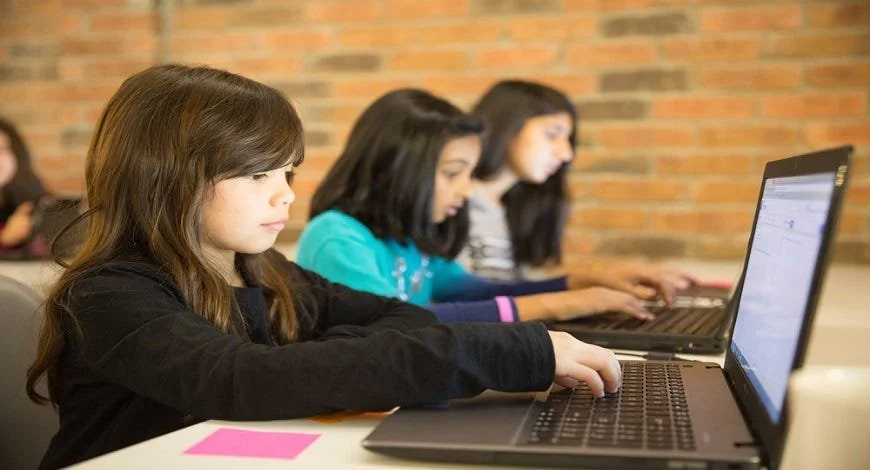
Artificial intelligence is rapidly becoming a staple of everyday learning. However, to harness these benefits, educators must also know how the technology works and what it can and cannot accomplish. This guide covers what educators should know about implementing AI in the classroom.
1. How AI Helps Teachers and Students
AI and software are not a threat to teachers’ jobs; they are designed to take over repetitive tasks, such as grading in the previous example. In education, numerous AI assistants can handle the same tasks, e.g., tracking attendance or creating progress cards.
Additionally, AI can personalize learning experiences for students. For example, platforms such as Khan Academy and Coursera adjust lessons to each student’s strong and weak points, showing key benefits of artificial intelligence in education.
In addition to increasing students’ involvement, as previously mentioned, EdWeek claims that it also affects their long-term memory, which is vital in an online or hybrid setting.
2. Making Learning More Accessible for Everyone
Various tools improve inclusion in the classroom. Students with special needs and those with limited English proficiency widely use AI products like speech-to-text, translation, and visual recognition.
For instance, to enable students with learning difficulties to read, Microsoft’s Immersive Reader and Google’s Live Caption are two examples of software that can be utilized. With the help of appropriate AI-assisted methods, it is possible to tailor courses so that everyone has an equal opportunity to succeed and learn about how teachers can use AI effectively.
Must Read: How Building Real Connections Sparks Innovation in an AI-Driven World
3. Using AI Responsibly and Ethically
The Brookings Institution states that topics such as data privacy and bias in algorithms require considerable measures. AI needs vast quantities of data, some of which is students’ personally identifiable information; thus, schools must also safeguard it when using AI in the classroom.
In addition to only utilizing platforms that adhere to the Family Educational Rights and Privacy Act, teachers must understand how algorithms work. Poor quality or unrepresentative information from the tool used to train AI can result in biased outcomes, which highlights major ethical considerations for AI in schools.
Students, parents, and educators will all be able to express confidence in one another if learners understand what teachers do and if instructors hold these data units to account.
Related Article: How You Can Build a Healthier Relationship With AI Technology
4. Preparing Students for an AI Future
According to the Pew Research Center, over 60% of workers believe that artificial intelligence technology will redefine the required skills in the sector in which they work over the next ten years. That’s why students require extensive knowledge of AI in the classroom rather than just practical experience.
AI literacy, including knowledge of how algorithms choose and how automation transforms society, props young people up for the future. Science-based and ethics-based lessons on AI advance the development of critical thinking and support preparing students for an AI future.
If young minds become aware of how AI functions at an early age, they will fit into the modern technology-infused job market and solve problems in everyday life more proficiently.
5. Keeping the Human Touch in Education
While AI can work with data and generate trends, it cannot replicate the human aspect. The Harvard Graduate School of Education emphasizes that compassion, teaching, and individual connections are critical foundations of successful teaching that AI in the classroom cannot fully replace.
The optimal use of AI is to address minor tasks, enabling humans to focus their time on what is truly important. Its gift is guidance to the right individuals, motivation, and aid.
Empowering Teachers Through AI
At its best, AI can revolutionize education. By supplementing data-driven technologies with empathy and judgment, educators can create more dynamic, effective, and forward-thinking classrooms. In the right light, AI isn’t just a way to de-emphasize the human side of teaching; it’s a method to create more room for it.


